Thursday, 18 August 2016

Mice mice, baby!

Last month I volunteered, along with some other awesome folk, to help out a fantastic PhD student (with Edinburgh University) with her field study on wood mice (Apodemus sylvaticus) in Callendar Wood near Falkirk. Amy Sweeny was looking at how nutrition affects the relationship between parasite infection risk, the immune response of the mice, and also their reproductive success in the wild. To do this there were 4 experimental grids of traps set out in the forest, two of them were used as controls where no food was added and the other two were supplemented with high protein food pellets - lucky mice!

Toni, Chris and Amy in the field

Apodemus sylvaticus - The Wood Mouse

Humane Sherman traps were set overnight 3 times a week baited with bedding and food, and checked the next morning to see if we had caught any unwilling participants :) Along the way we met many of the varied characters of the wood, including the distinctly smelly but charismatic bank vole, the occasional shrew, frogs and even a wren! When we did catch a wood mouse we took the trap back to the field base where the mice were sexed, roughly aged, weighed, measured, microchipped and had a wee bit of blood taken to check for infection. They were also checked for fleas, mites and ticks which were removed, so many of the mice were released feeling a lot cleaner for their trouble. Some mice were randomly treated with anti-helminthic drugs which got rid of any parasitic nasties such as tapeworms that they might have had living in their gut.

If any of the captured mice were pregnant or showing signs of being so or lactating, they were gently released back into the wood to provide for the next generation :)

Bag of cuteness
Bank vole (smells like cereal and wee!)

Of course science isn't all flowers and rainbows as you may already know, and a sample of the mice in the study that had been recaptured at a later date were sacrificed in order to carry out dissections and find out more about the kind of parasites they carry and the effects of co-infection (infection with multiple different parasites). This study falls under the fairly recent term of 'wild immunology', where scientists try to find out how animal immune systems deal with threats in their natural wild environment. It is somewhat easy to look at the effects of just one disease or parasite under lab conditions with inbred mice that are genetically alike, but much more difficult with many unknowns in the wild because there is tremendous variation to consider which has a bearing on how well the animal fights these infections. Things such as age, life history, infection history (what diseases/infections they may have had in the past), habitat, reproductive history, and genetics are just a few of the variable that add to the complex nature of wild immunology! You can find out more information here.

I had a fantastically fun and educational time helping out with the study so many thanks to Amy and the team for the opportunity :)

Wednesday, 27 July 2016

St Kilda

We have just returned from an action packed trip through the Outer Hebrides and a weekend of wildlife photography in Knapdale and Tayvallich! We saw the sights such as the Calanais stones, Butt of Lewis, blackhouses and brochs, but our main focus was on beachcombing and wildlife spotting.

The beaches of the western isles look like they should be somewhere in the Caribbean, with vast expanses of golden sand and turquoise water. The weather definitely reminds you that you in Scotland though that's for sure, the wind never really died down at all which was great in a way as it kept the midges away. In terms of finding stuff washed up on the beach, our hauls were not as good as we expected them to be, but still pretty exciting. Oystercatchers were EVERYWHERE being fiercely protective of their territories, as were Lapwings making their weird wittery noises in the fields.


Most of my beachcombing finds were bones and skulls. I have a couple of cow vertebrae, fulmar skull, some unidentified incisors, a wading bird skull that I've still to ID and an otter skull! We were also lucky enough to go on a trip to St Kilda, an isolated island 41 miles west of Benbecula which is now a world heritage site. It is also home to a prehistoric breed of sheep know as Soay which because they are isolated on the island, have remained virtually unchanged for centuries! There have been genetic studies carried out on the population for the past 50 years and so it was very exciting to meet some of them. Shortly after we landed we also met the St Kilda Wren which is a subspecies of the wren found in the UK but slightly bigger in size. There is also an endemic St Kilda mouse but perhaps unsurprisingly we never bumped into one :)

St Kilda Wren

Soay lamb

Gannet colonies on the stac

After we had climbed a little way up the hill to look over the cliff, met with a pair of great skuas (on 'bonxies' as they are known in Scotland) and their fluffy chick, and explored the remains of the village in the bay, we had a quick tour around the stacs before we had to head home. The sea stacs around St Kilda are important breeding sites for gannets, puffins, fulmars and guillemots. The inhabitants of St Kilda used to row out to the stacs and scale the steep craggy cliffs to catch the birds for food, they were definitely a brave and hardy folk! It was amazing just how many there were covering and flying around the stacs, and I'd never seen so many puffins in my life, there are thought to be up to 136,000 pairs!

Great Skua in flight

One of the many puffins and guillemots
Gannet on the wing

Monday, 6 June 2016

The end of an era

Well folks, I've finally come to the end of my four years as an undergraduate and I am pleased to report that I come away with a 2:1 in Marine & Freshwater Biology! :D

'What's next?' I hear you ask...well I'm not completely sure at the moment. I've been looking for an applying to ecology junior type jobs and also some on connecting nature and kids education, however in the meantime I will be doing some volunteering to help studying the wild immunology of the wood mouse, Apodemus sylvaticus!

In other news I am heading off on a trip to the Outer Hebrides soon and hope to report back on any creepy crawlies I might find on my travels. Also check out National Insect Week (20th - 26th June) and see if you can get involved in any of the activities, and there's also Glasgow Science Festival (which I'll sadly miss!) with all kinds of events running from the 9th to 19th June!

Wednesday, 2 March 2016

Sorry, I don't have any puns this time

Again, I appear after months of radio silence! If you're a student or academic then you'll understand when I say 4th Year Honors Project...I've been pretty busy doing that as well as revising for exams at the end of April.

Last time we spoke I had just identified all the samples of freshwater invertebrates that I took from 3 streams on the Campsies. I did a little spot of data analysis and found what looked to be a relationship between where my species of interest (the Upland Mayfly) was found and the order of the stream it was found in. So we went back out in January to gather some more data (in the form of more kick samples) at a different location - on a tributary of the Culter, which was charmingly covered in a good layer of snow at the time :)

I've since tested this data but it's not really showing a similar pattern to the first lot, but that may be due a number of reasons, but not to worry! On the whole I'm finding the data analysis very confusing and find myself frequently doubting what I've done. It doesn't help that when I do a bit of internet research for help that it seems to constantly contradict what I've been taught in the past. There are so many statistical tests that you can carry out and so many that have certain assumptions that it's very easy to become overwhelmed and lose sight of what you are trying to do in the first place. I'm hoping to get a bit of guidance this week to put me at ease - or alternatively I'll have to do all my analysis again!

In other news, I managed to get back out CRIMPing again for the first time since November, mainly due to the weather over the winter, and general lack of free-time. The haul was pretty good but I did notice that there were a few freshwater hoglice and blackfly larvae, something that I've never come across in my samples since starting the monitoring program, however there were plenty of mayflies and stoneflies present indicating good water quality as usual.

Here's a photo of a nice big stonefly, one of two that we caught.


Well, into the breach once more dear friends, see you on the other side!

Friday, 6 November 2015

Amelet you finish...

So....long time no post eh? Well I've been a busy bunny during the summer and more recently at university, now that I'm in my final year honors projects have kicked off and I'm currently in the midst of my own!

I knew I wanted to focus on riverflies and I had a helpful nudge in the direction of studying Ameletus inopinatus, an upland species of mayfly usually found in small streams above 300m. The experiment underwent many permutations in the planning stage but I've since been out in the field (the Campsie Fells to be precise) to do my fieldwork. I'm going to be looking to see if stream order has an effect on the distribution of the species, and then also look at the relationship between Ameletus and its freshwater habitat-sharing buddies.

Obtaining my samples was a sweaty job which involved gallumphing up tussock and moss covered hills which were riddled with drainage ditches and jaggy thistles, all while wearing chest waders, a fleece and rainjacket, just in case! Oh yes and lets not forget carrying the net and sample tubs - thankfully I had some expert help and only disappeared into a hole a couple of times.


See that little burn on the left? That's what I was trying to kick sample in :)

 I collected 45 one minute kick samples in total, taken from 3 different streams and at various altitudes. Right now I'm settled into the lab work and steadily working through all the samples to pick out the inverts from all the moss and other guff I managed to catch in the net. Here's few snaps of the wee guys I'm discovered so far that inhabitt this seemingly bleak and empty habitat:

Nice juicy stonefly

Some microcaddis, or Hydrophilidae, their cases lok like seeds!
Caddisfly larva
Many of the inverts I find while sorting through the samples are barely a millimeter long, there are tiny limpets, snails, pea mussels and of course tiny riverfly larvae too. The next stage will be trying to identify and count the communities that I've managed to find, then it's onto the stats and trying to make sense of it all!


Sunday, 10 May 2015

Bear hunting


Magnified tardigrade (from http://www.sciencephoto.com/media/481794/view)

Today I did something I've been meaning to do for years - hunt for tardigrades in the garden!
Tardigrades are arthropods of the class Tardigrada, they are often called 'water bears' or 'mosspigs', which is where the name of my blog comes from. They are usually 0.1 - 0.5 mm long and can be found living in the damp moss or lichen that grows on trees and walls.

Since Unky Steve was kind enough to bestow me with a classic binocular microscope recently, so I thought there was nothing better to take it for a test run on than a tardigrade hunt!


In the garden i took a couple of pinches of moss from the garden wall, the bottom of a tree, and a pinch of green lichen from the same tree, putting them into separate small plastic bags to be examined later. I transferred the samples to three petri dishes and filled them with water to submerge the moss.

Samples L - R: Lichen, Tree Moss, Wall Moss


After leaving them to soak for a bit I started my search in the lichen but unfortunately the was nothing much to be found. In the tree moss sample I found myself in bear country, with my first ever tardigrade waving at me after only a few seconds of searching :)

The little white thing with stumps in the centre of the photo is a tardigrade, I promise!
Here's a video of the little guy, probably best to make it full screen :)


Tardigrade next to the tip of a mounted needle
Moss pigs are extremely hardy creatures, you might have heard that some have been sent into space and have survived being outside in the radiation and vacuum of outer space. They can also withstand temperatures from just above absolute zero (-272.8) to above 100 degrees Celsius, and are able to survive extreme drying out, or dessication, by going into a period of suspended animation called cryptobiosis from which they can be reanimated just by adding water! It is thought that they evolved these amazing adaptations in the move from the oceans, where they originally evolved, onto land. It might be difficult to visualise just how tiny these guys are, so see below for a comparison with a mounted needle.

Mounted needle with my forefinger for scale.
The tiny jungle of moss also harbors many other organisms, including countless nematode worms, mites and rotifers. Rotifers are also called 'wheel animals', as they have a structure on their head called a corona, which has loads of tiny hairs (cilia) used to sweep food into the mouth. Certain species (out of over 2000) of these guys called Bdeloid rotifers can survive long periods of dessication similar to the tardigrades. They also have strange sex lives and are able to reproduce without males (parthogenesis) which enables them to survive less favourable environmental conditions.

A rotifer.
The view down my microscope: Nematode bottom left, rotifer top centre.

You can read all about the remarkable moss pig in greater detail at this BBC article, and delve into the weird world of rotifers here!

Saturday, 21 March 2015

Everything is awesome


It's been a busy 10 days out on the Glasgow University Marine and Freshwater Biology field course based on Millport, Isle of Cumbrae! The trip kicked off with a 3 day Environmental Impact Assessment module led by the adorable Peter and Azra Meadows. The task involved working as a group to assess the current ecological status of the sea floor around Hunterston Power Station in light of a (historically accurate but pretend) proposal to build a new coal-fired power station on the site.

Map of our beam trawl transects and sediment grab points
Being 27 students strong, it was admittedly a bit tension-filled trying to make decisions on how we we go about sampling but we got there in the end :) Four sample sites were decided on with a beam trawl and a sediment grab planned for each, with groups going out on the R.V. Actinia to see how it's done. The skippers Duncan and Tom were brilliantly knowledgeable about the area and the sampling techniques and had some great stories to tell.

While one group was out on the boat, everyone else was involved in the processing of the catches and data collection. It was a marine biology conveyor belt with sorting, identifying, counting, sifting, and weighing all going on at once. Of course it isn't all cuddling crabs and stroking starfish (!), we had some serious stats and report writing to do, as well as fit in lectures and briefings on what was coming up the next day - saying we were tired just doesn't cut it!

Our beam trawl haul!
Peter and Azra kindly provided a glut of wine on the Friday night so we all had a chance to cut loose for a time before the report was due in and the zoologist hoarde arrived the next day!

The Marine and Freshwater Ecosystems course kicked into gear on Sunday morning, when we headed out to Farland Point to collect some rocky shore specimens, and Kames Bay in Millport itself to dig for sandy shore beasties. At the rocky shore we took representative species from each zone - the Sublittoral (below the water line), eulittoral (between the kelp of the sublittoral and the furthest reach of the barnacles, and the littoral fringe (above the barnacles to the black lichen). We found a few shore crabs, common mussles, chitons, isopods, amphipods and anemones, as well a lots of different types of alga or seaweed.

At the sandy beach the fauna was dominated by some of my favourites - polychaete worms! The largest among the ones we found were estuary ragworms, which undulate from side to side with the wave of movement coming from the tail to the head. This means their heads are constantly waggling from side to side - they look hilarious.

Nephyts caeca - a polychaete worm
 Monday saw us back out on the Actinia to collect some plankton samples and measure light availability below the surface of the water. On Tuesday we were briefed about a scientific video we had to make, testing our skills in presenting a scientific paper in a fun an engaging way - the results of our efforts were screened on Friday afternoon and I had no voice left from laughing so much. You can watch the masterpiece that is CSI: Millport below, let us know what you think!


We also had a chance to check out our plankton samples under the microscope. Plankton are tiny organisms, and can be photosynthetic plants (phytoplankton) or larval forms of sea life (zooplankton) that are carried by the ocean currents. We found diatoms with surfaces made of sillica, dinoflagellates, tiny polychaete worms and crustacean larvae wriggling around in a tiny drop of sea water, a world within a world.
Gammarid and polychaete worm larvae under the microscope


Squat lobster and a dragonet fish
Wednesday saw us in the lab for some microbiology work on two water samples to see if E. coli and other colliform bacteria would grow on agar plates. Our results were very different from previous years success as we hardly had any colonies growing overnight at all. I must admit that microbiology is probably wasted on me, I like my study subjects to be visible ;) In the afternoon though our groups choose different rockpools and we collected hermit crabs from a .25m quadrat, painting their shells with colourful nailpolish before releasing them back to their pool. We would return the next day to see if they went for a wander to see their neighbours or not. That afternoon we also did a 75 minute study on oyster catchers, watching one bird to see how much time it spent watching for predators and feeding. Thankfully the weather was great if a bit chilly and we were rewarded with a lovely sunset before we headed home for tea. Wednesday was also St Paddy's and after the fieldwork was done we headed to the pub to celebrate - what we didn't expect was the pub running out of Guinness minutes after we arrived!


Looks like I should have used some of the polish myself


On our penultimate day we went to check our rockpools and try to find our painted hermit crab pals. Our group found 2 out of 5 that had been painted and about 15 other unpainted crabs which had moved into the area. The two that we found had moved out of their shells - maybe they didn't like the lavender colour?!  We also conducted a quadrat hurling rocky shore survey where we flung the wire square over our heads and counted how many periwinkles, mussels and limpets were within the boundary. In the evening the tutors held a fun but competitive review quiz, complete with table wine. Our team came joint second with 31.5 points out of 40 which wasn't too shabby!

Friday came after what seemed like months of work, dry ham sandwiches, hangovers, copious cups of tea and no sleep. There was a last minute rush to finish some group videos and then experience the enjoyment of everyone's hard work in a dark and stuffy lecture theater while the moon covered the sun behind the clouds outside. I may have almost lost track of all the things we learned but I had an absolutely fantastic time which I will never forget!


Saturday, 21 February 2015

Latest stuff

Taxidermy reprise: here's a lady stoat completed this week, carrying a wee field vole which was found along with the stoat when it was caught (in a legal, lethal spring trap, though not by me).


Teeny vole pelt
If you'd like to see more you can head over to Stuff Stef Stuffs facebook page :)

Wednesday, 4 February 2015

Build a little worm house in your gut!

I have, in my time kick sampling, come across more than a few amphipods of the Gammarus pulex variety with bright orange patches showing through the side of their body, and have never known what they were - UNTIL NOW!

Gammarus pulex showing infection with Pomphorhynchus laevis.

Through the magic of learning (which is fun by the way) in the form of lectures on parasite biology at university, I am now excited to share that these orangey bits are actually internal parasites! Going by the beautifully unwieldy name Pomphorhynchus laevis, the eggs of these acanthocephalan (spiny headed) worms are eaten by, and make their way into the gut of unsuspecting Gammarids (freshwater shrimp). What is particularly interesting about these parasites is that they can change the behaviour of Gammarus to increase their chances of making their way to their definitive host - a fish.

It has been shown that the bright colouration of the infective stage of Pomphorhynchus laevis is more easily spotted by fish such as trout and three-spined stickleback, the natural predators of Gammarus in streams and rivers. The parasite also changes the normal behaviour of the amphipod, causing it to be less sensitive to light which results in it spending more time in the open, or against light coloured gravel. It may also alter its sense of smell, making it unable to detect the scent of predators and flee. This makes them 'sitting ducks' so that hungry hunting fish can easily gobble them up!

You might think this is bad news for the parasite, when it is actually exactly what it wants as it ends up in the gut of its ultimate host where it is able to reproduce, release eggs which are expelled in the fish's faeces and start the cycle all over again. Some parasite species have extremely complicated life histories, going through many life stages in different forms and enduring exposure to different environments. For me it's a marvel how intimately parasites and their hosts have co-evolved over millions of years: developing adaptations to their host's immune system to avoid detection and death, ensuring that the next generation is spread to where the intermediate host will be, and also in some cases altering their intermediate host's behaviour in order to get where they need to be for the next life stage.

A scary acanthocephalan worm (From http://www.carlsbergfondet.dk/~/media/Images/Forskerartikler/torskens%20spaende%20indre%20liv/lille%20illustration_version%201.ashx)

Of course it can be bad news for the infected fish if it ends up with too many hangers on inside its gut! A heavy load of spiny headed worms can reduce the weight and condition of the fish host and eventually lead to death.

Ahem. Well it's not all doom and gloom, our hook-headed pal has enabled some cool strides to be made in healing wounds. The hooks have inspired a micro needle design which can be used to attach skin grafts which are less damaging and more secure than conventional surgical staples. Also other parasites are being used in trials to treat autoimmune disease such as MS.

Huzzah for parasites!

Oh and tiny bit of self-promotion - you can get my blog posts delivered right to your email by signing up via the box on the top right hand side, and if you like sporadic nature and taxidermy updates and links you can subscribe to my Twitter feed! :)

Tuesday, 27 January 2015

On Cousteau

I received a series of Jacques Cousteau DVDs for Christmas this year which was an excellent present for a budding marine & freshwater biologist ;)


If you did not already know, Cousteau was a French naval officer, explorer, conservationist, scientist, filmmaker and researcher who along with Emile Gagnan developed the aqualung (or SCUBA system as it is known today) in the early 1940s. He was also a pioneering marine biologist and traveled the oceans during with his son and crew on the adapted marine biology station ship, Calypso, for the series The Undersea World of Jacques Cousteau between 1966 and '76. He developed mini submersible exploration vehicles which were launched from Calypso and enabled him to film amazing scenes of life underwater and bring attention to the negative human impact on the oceans.

He also predicted the existence and use of echolocation in porpoises as he observed them finding the optimal course through the Straits of Gibraltar without following a boat. He certainly was a busy monsieur!

Of course marine biology was a bit different back then, and some of the 'techniques' used to study the animal life would definitely be frowned upon today! Here are a couple of examples:

  • Trapping tropical fish under plastic domes while their natural predators try to get at them and eat them.
  • Prodding a pufferfish until it inflates itself.
  • Drilling a hole at the rear of a turtle's carapace (which does not cause the animal any pain) and tying a hydrogen balloon to it to track them.
  • Attaching a plastic ball float to a fin whale to track it, combined with divers hanging on to its tail and fin for a bit of a ride before they let it go about its business.
  • Securing a tag to a juvenile sperm whale with string around its body.

Monsieur Cousteau riding a turtle, as you do.

Despite the perhaps slightly dubious methods, there are many fantastic insights into the deep sea including a couple of species and behaviours that I hadn't seen on other natural history documentaries (even recent ones) before.

An additional bonus for me was that the series is narrated by Rod Serling of The Twilight Zone fame, which, for those that are too young, is referenced in Futurama's The Scary Door! The series is seriously worth a watch :)

Next up on Mosspig - the first CRIMP survey of 2015!

Monday, 5 January 2015

Oh Canada!


The view from Moresby Floating Camp on Haida Gwaii

To wrap up the loose ends from 2014 I am finally getting around to writing about the wildlife we saw when we visited the west coast of Canada. We toured around Haida Gwaii (formerly known as the Queen Charlotte Islands) and managed to see most of Vancouver Island too. We were incredibly lucky in that we hit most of the big scores in terms of animal spotting. I realise that lists are sometimes dull and boring but I'm sticking them in here anyway!

Birds
  • Tufted puffin
    Tufted puffin ((Fratercula cirrhata) around Haida Gwaii
  • Ancient murrelet
  • Pigeon guillemot
  • Belted kingfisher
  • Loon
  • Bald eagle
  • Raven
  • Chickadee
  • Rhinoceros auklet
  • Sandhill crane
  • Semi-pilated plover
  • Turkey vulture
  • Blue heron
  • Steller's jay
    Bald eagle - Haliaeetus leucocephalus
  • Sandpiper
  • Shearwater
  • Barred owl
  • White winged scoter
  • Wood duck
  • Sap sucker
  • American Robin

Yes, we saw a huge variety of birds and spent a great deal of time trying to get half decent photographs of them. Of course the most iconic one is perhaps the bald eagle, of which we saw many as we made our way around both islands. There was one particular creek on Haida Gwaii where we stopped for lunch which was jam packed with adult and juvenile eagles, some flying very closely past us. One of the memorable species was the ancient murrelet, which had a frantic and slightly ineffectual flapping flight using their stubby wings whenever the boat got too near. Haida Gwaii has the largest breeding colony of ancient murrelets in the world don't you know.

One of the birds we had a particularly hard time trying to photograph was Steller's Jay, and on one occasion following one with the camera led us to a very well camoflaged, sleeping, barred owl!

Mammals
  • Humpback whale
    Pacific White Sided Dolphin - Lagenorhynchus obliquidens
  • Sitka black tailed deer
  • Haida Gwaii black bear
  • Squirrel (various)
  • Pacific harbour seal
  • Steller sea lion
  • Bats
  • Killer whale
  • Pacific white sided dolphin
  • Grizzly bear
  • Californian sea lion
  • Racoon

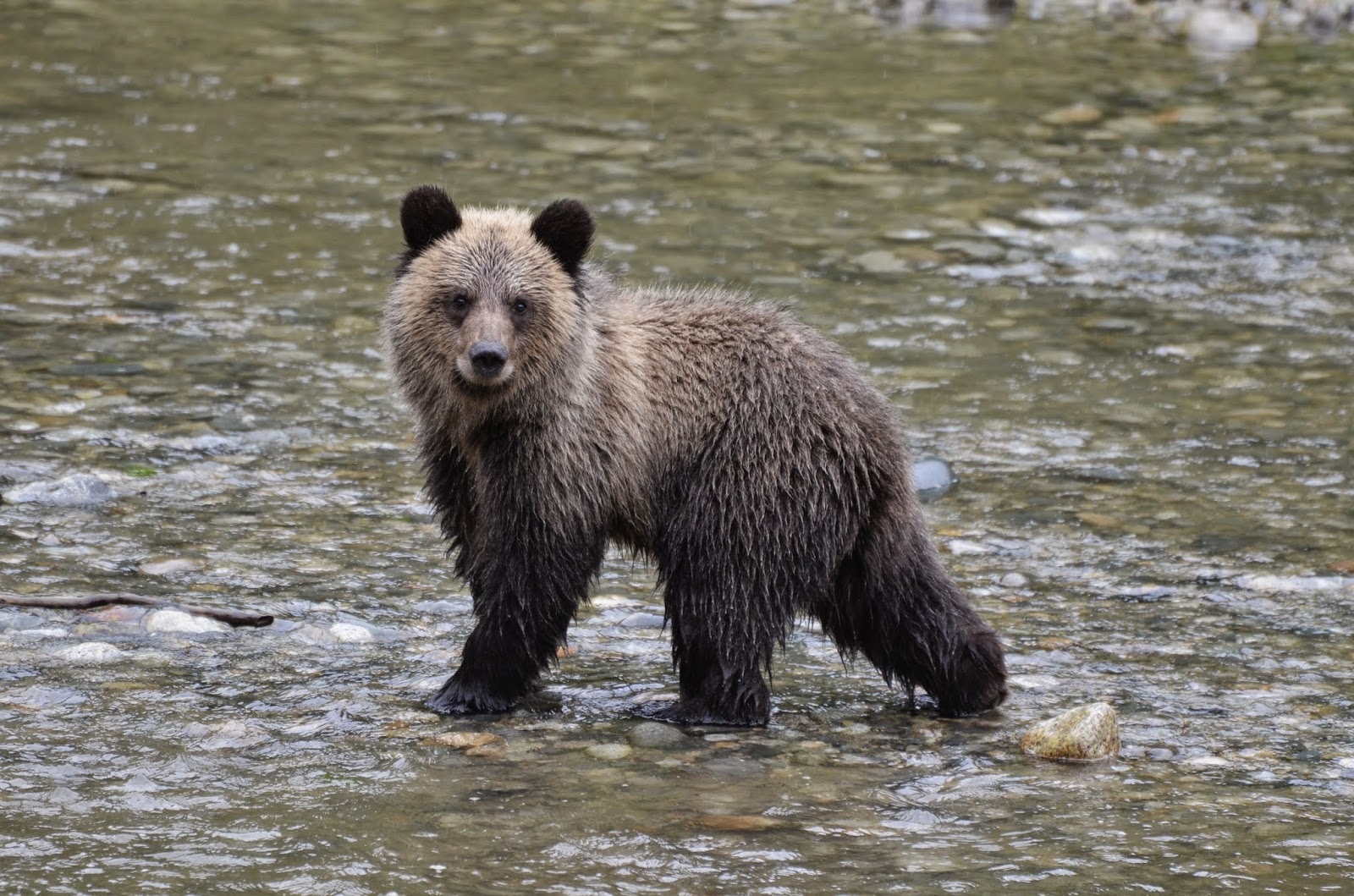
We spent a lot of our time in the lead up to going to Canada hoping that we'd see bears and whales, and we were definitely not disappointed! Shortly after we had arrived on Haida Gwaii a black bear lolloped across the road in front of our bus. The grizzly tour that we went on in Campbell River  provided us with spectacular viewings of humpback whales, a pod of killer whales, pods of pacific white sided dolphin and of course the beautiful grizzlies. We managed to see five bears in total on the tour, two female and cub pairs and one lone individual, and all turned up just shortly after we had climbed into the hide!

Grizzly bears - Ursus arctos horribilis

The mother bears looked very lean but were obviously doing well as the cubs were one and two years old respectively. They came so close to where we were watching them but didn't pay much mind. They skirted the icy blue glacier river and one mother even dived in attempting to catch a salmon.


What a amazing unforgettable day that was! When we were nearing the end of our holiday we booked on a whale watching tour in Victoria and were also very lucky to catch a couple of big humpbacks breaching out of the water. There are different theories as to why humpbacks perfom this behaviour ranging from social displays of dominance, playing, dislodging parasites or to stun prey. Humpbacks are mysticete whales meaning they have baleen plates in their mouths instead of teeth which they use to filter feed on small crustaceans and fish. They are generally solitary animals but the males are well known for their haunting and complex songs produced to attract a female during the breeding season.

Humpback whale Megaptera novaeangliae

Other behaviour we observed while on the inside passage ferry were tail and fin slapping by two different individuals, which was great to see.  Tail slapping, or lobtailing as it is often called, creates a sound that can be heard for several hundred meters underwater, it may be a form of communication or feeding method to encourage frightened fish to school together to make them easier to catch.

Humpback tail fluke patterns and notches can be used to identify individual whales

Fish, amphibians and invertebrates
Sunfish Mola mola
  • Sunfish
  • Banana slug
  • Sculpin
  • Purple or Ochre starfish
  • Northern kelp crab
  • Fried egg jellyfish
  • Grasshopper
  • Isopods
  • Mossy and Black Katy Chitons
  • Carabid ground beetles
  • Tussock moth caterpillar
  • Western red backed salamander
  • By-the-wind sailor jellyfish

One of the weirdest things we encountered was a sunfish, a giant meter and a half laterally flattened silvery grey creature with huge oar-like dorsal and anal fins. It is apparently the heaviest bony fish in the world reaching weights of 1000kg. They mainly eat jellyfish and are very slow moving and a result can end up with a lot of hangers-on in the form of parasitic species (and they can be troubled by as many as 40 different ones!), which we observed on ours! Sunfish sometimes come to the surface for a clean, and allow birds to eat parasites from them, at the surface they can also take advantage of the warmer temperature and thermally recharge before they dive.

Mossy chiton Mopalia muscosa
It wouldn't be a Mosspig blog without some mention of inverts so I'd like to highlight the chitons we found on Botanical Beach at Port Renfrew. These are molluscs of the polyplacophora class which have 8 overlapping parts to their shell made of calcium carbonate, which enables them to fit very snugly against intertidal rocks to lock in moisture and avoid becoming dislodged by the waves. Like snails, chitons have rasping tongues called the radula, which are covered in ordered rows of tiny teeth. These are used to scrape algae from rocks on which the chiton feeds. A surprising thing however, is that chiton are the only animals that are able to tip their radular teeth with a compound called magnetite which is the hardest material made by a living organism! There are chitons present on Scottish rocky beaches of course but I have never seen them as big as the ones in BC. There is also a really weird story in Haida culture regarding chitons and their involvement in the creation of man which is worth a read.

Tussock moth caterpillar Lophocampa maculata
Banana slug - Ariolimax columbianus
One of my favourite 'underdog' spottings was the humble banana slug. They are present in North America's Pacific coastal coniferous forests, but the ones we saw in British Columbia are an isolated population. They are very important as they are detrivores, which means they feed on decaying vegetation, animal droppings and fungal fruiting bodies which enables recycling of nutrients and a clean and healthy forest. They are also a tasty snack for some birds and mammals, and I think they are very charismatic!


Of course I can't end a post about British Columbia without mentioning salmon. There are many different species in Canadian waters including Sockeye, Coho, Chum, Pink and Chinook. They all start life in interior rivers, migrating out to sea where they feed and grow, and then return as adults to spawn in their natal river. The return of the salmon is a huge and important event for the bears who after a summer of eating fruits, nuts and scavenging carcasses, can gorge on the glut of salmon biomass in the fall. Bears and other carnivores that hunt the salmon enrich the local ecosystem by transporting nutrient-rich flesh onto the land and into the forests. There valuable phosphorus, carbon, sulphur and nitrogen and be broken down and taken up by plants and trees, as well as being transported downstream to estuaries where it can support a wide variety of invertebrate and birdlife. Mon the salmon!

Sockeye mural in Prince Rupert

In conclusion I thoroughly recommend exploring British Columbia and especially Haida Gwaii and Vancouver Island if you ever get the chance, it is a beautiful area bursting with amazing creatures as well as fantastic scenery.