Wednesday, 18 June 2014

I ran

Lady Isle from the boat
Today I joined Nina (who is doing her PhD on sea bird ecology) as a volunteer on a trip to Lady Isle, a small island with breeding colonies of herring gull and shag in the Firth of Clyde. Up and ready at 7.30am a glorious day awaited us via a smooth boat trip and quick outboard to the shore. I was posted on 3-hour Nest-Watch with Maureen (a masters student studying tagging related to stress). I had a comfy camping chair with self-contained hide that pulled over the top, and set to work trying to identify nests on the rocky shore. It's harder than it seems as the grey speckled chicks blend into the rocks and often disappear behind them! During the watch I logged the number of adults at chicks at each nest at the beginning and then at 5 minute intervals how many adults were present and any provisioning (feeding) or disturbance events. It's very tricky trying to work out which chicks belong to what parents but I used my best judgement so hopefully the data will be useful.

Spot the chick!
 I did see a few provisioning events but working out what kind of food was being offered is another matter altogether - orange stuff could have been crab. Mmm crab :P

Making our way the relatively short distance between the lighthouse and the shore was complicated by there being hidden gulls nests in the long grass, forcing us to pick our way slowly through. On the way there were a fair few dead chicks, the coastal survival rate is less than that of urban gulls, generally about 0.82 (data from Skomer in South Wales).


The view from the hide

:(
 
Shag Pile

There are also Shags breeding on Lady Isle but this time we didn't collect any data for them, only listen to their throaty calls. After a quick lunch we spent some time searching for gulls that were ringed last year. I had photographed a couple on my watch but we found about 3 more in the afternoon. Some of them have GPS loggers attached to them to track where they are foraging for food. I think there have been some problems with with the antennae picking up the data and possible with the scapular feathers covering the solar panel that is used to charge the device. Lessons learned!

Ringed Herring Gull

Taking measurements

While I was watching the nests Dave and Nina were catching, measuring, weighing and ringing 25 chicks! I got to get my grabby hands on one as well :)

Gull chick freshly tagged!

Ullo!


There's not much love for gulls generally but when you spend some time observing them they can be quite charismatic.


 The noise and the smell of the gulls is literally intoxicating, but you do get used to it fairly quickly. I was surprised I wasn't covered in shit by the end of the day with the amount that was getting sprayed around, guess I'm lucky this time. I did have shower when I got home though :)


Tripping over nests!

Oor wee boat

The lightouse and warden's hut
I'm keeping my ears open for the next seabird opportunity, maybe I'll get to catch some chicks!

Friday, 9 May 2014

Glasgow Museum Resource Centre

Today was a pretty exciting day. R and I went on a tour of the Glasgow Museum Resource Centre in Nitshill.


Because Glasgow City Council has around 1.4 million objects, they can't all be displayed all the time, in fact only 2% of the collection is on show so this is where the rest live! There are 17 purpose built 'pods' split into categories such as Archaeology, Art and Painting, Arms and Armour, Natural History, Transport and Technology and World Cultures.

It's open to public viewing as long as you book a tour in advance, you can also specify what you are interested in seeing and they'll accommodate you as best they can. Of course when I booked the tour I might have mentioned my love of taxidermy...

The first pod was Art & Painting, and let me tell you, it was almost akin to walking into the storage room at the end of Indiana Jones Raider of the Lost Ark:


Hundreds of original paintings and prints are contained within the racks, and we were party to a Lowry, Warhol, Degas and Cezanne as well as some others I forget before being led through a maze of grey corridors and an seemingly unnecessary amount of doors to the next pod. On the way we could see into rooms where the conservation of art works was taking place. We also visited the World Cultures pod which was crammed full of curious and beautiful objects from far flung places, including a huge intricately carved elephant tusk with gilt silver end.

When we stepped through the next door I could barely contain my squee...


So much taxidermy! I mean wall-to-wall stuffage, I was like a kid in a sweet shop (of the skins of dead animals). As well as the mountains of whole taxidermy there was also a collection of illegal/restricted goods seized at Glasgow Airport customs such as ivory and marine turtle shells. 

It was interesting to find out that the curator uses plaster cast moulding of the carcass along with fibreglass and woodchips to sculpt the forms. Here's a half-n-half example:


Owls!

Pheasants! (and a great bustard on the bottom left)

Gulls

Baby Giraffe

Very old cheetah

Need a rabbit, hare or badger?

Wombat and cat with kitten


There's also some mighty fine crappy taxidermy examples

Tapir

Handsome Walrus

Lifelike dog

Lynx with with odd and even toed ungulates!

We're definitely going back to look more closely and see some of the pods we missed :D
If you'd like to book a tour check out the website

Wednesday, 9 April 2014

Trilobites and Treerats

Eep, no posts since October last year - well I've mostly been concentrating on university and also haven't really been out in the wilds a whole lot over winter. We did manage a few walks to Mugdock Country park, Killiecrankie and Callender as well as a fruitful trip to Trearne Quarry in Ayrshire where we came back with a few quality brachiopod and coral fossils!


Our Carboniferous haul mostly included Productids, rugose corals and tabulate corals, and we also got some photos of bryozoan mats and possible echinoderm spines.

I also finally got around to doing some taxidermy on a female grey squirrel I picked up off the side of the road last year (don't panic, its been in freezer!). I actually started it a couple of months ago, it took me most of the day just to skin it, and then I got it back out again the other day to finish. It really shouldn't be taking two days to taxidermy a squirrel >.<


I've only used a pre-made foam body form once in my work so far (on Douglas the stoat), I much prefer the woodwool wrapping method, that way you can hold the form up to the actual carcass and get a much better feel for the measurements and ability to change things before it's too late. It also gives you freedom over the final pose, you can muck about and tweak it several times before you leave it to dry. ...And it's a pretty traditional old school method, I've seen some commercial taxidermists slag it off and argue that it takes too long and isn't economical, but I don't think it makes any difference time wise on small mammals or birds to be honest. I was originally going to mount it on a piece of wood but we're running out of shelfspace so for a change I've left it free standing.
Some people were wondering about the pins liberally stuck into poor Nutkin, thinking it was some weird voodoo acupuncture thing - they're there to keep the eyelids, mouth, ears and toes in place while the skin dries over the course of a week or so. As the skin dries it tightens a bit and so things that aren't stuck down tend to move around!

It's not perfect, one of the eyes is more pushed in than the other but you only really notice when you look head on. The chest is a bit too far forward and there are a few small annoying bald patches which im asssuming are a result of it being it by a car rather than the fur slipping during skinning (as I didn't see any clumps come out when i was doing it!). Overall I'm quite pleased with how she's been drying.

Next on the list is a half-finished stoat (yes another one) which I'm planning to mount on a piece of wood with a vole in it's mouth :)

Tuesday, 22 October 2013

Taxidermy interlude: Wheatear


 Here's a juvenile wheatear I finished on Saturday.

The wheatear is a summer visitor in this country, they like to hop and run around open ground in upland habitats eating insects. The adults have very striking colouration and the name comes from a linguistic corruption of 'white arse' from the prominent white rump. This unfortunate chap was spotted after it clunked into a window at SASA during high winds last year.


 He was very fiddly to do, I would say even more so than the robin and its larger! Songbirds have paper thin skin so it's very easy to perforate if you're not careful. His right eye was damaged, i tried to reconstruct the eyelid with the aid of superglue but it was a fiddly job and didn't turn out that great. His left side looks ok though.


Next on the list is either a grey squirrel, rabbit, or stoat with a vole...vote now!


In other news, we've discovered we have another bluetit using our birdbox to roost in :)


Lets hope he or she will find a mate and build a little nest in there in the spring.

Tuesday, 8 October 2013

RSPB Volunteers day

If you have been following my adventures you will know that I recently did a two week stint at RSPB Forsinard reserve. Shortly after I returned I received an invitation to the RSPB Volunteer Day in Stirling, which was nice! It was held in the university and comprised of a main hall featuring stands from BTO, iSpot, Butterfly Conservation, Marine Conservation Society and various reserves.
The day began with a  welcome talk by the director, Stuart Housden, where success stories were shared and the RSPB's change in focus was outlined (as you may have seen in the recent advertising campaign 'Give Nature a Home'). The change in image is a lot to do with the importance of conserving ecosystems and biodiversity within them rather than just focusing on key species. The RSPB have had this wider approach for quite a while however the general public tend still to think 'birds' when someone mentions the name, rather than all of nature. There is evidence that these perceptions are changing, which is brilliant of course, and also the knowledge that organisations such as RSPB are working alongside other conservation charities large and small for the benefit of nature.

There were a series of workshops available in the morning and afternoon, and I prebooked on Owl Pellet Dissection just before lunch (!) and RSPB Loch Lomond in the afternoon. I have picked apart owl pellets before but was keen to go into a bit more detail and find out what species the various bones inside belonged to. For those who can't tell puke from poo - pellets are the regurgitated remains of a bird's meal, which can include indigestible parts such as bones, claws, fur and feathers. In the gizzard the rest of the fleshy parts are dissolved by acidic juices and digested, the remains are then thrown back up around 6 hours after the meal has been eaten. They are often found around favourite perches near fenceposts or barn doors etc.
Our pellets had been presoaked to make it easier to pull out small bones. They were also crawling with clothes moth larvae and pupae to make it even more fun :) As you pull the dark mass apart you immediately start to see skulls, both intact and in bits, mandibles and then larger leg bones such as the femur, then working down to rib bones and finally tiny tarsus and metatarsus.

Apologies for the rubbish phone photo

In my pellet there were a couple of field vole (a rodent) skulls along with 3 common shrew skulls! You can tell the shrew by it's wedge-shaped cranium and sometimes you can see the tips of the jagged insectivorous teeth are red in colour. One vole tooth was able to be pulled out of the lower jaw and it was almost the length of the entire jaw itself! This is due to rodents wearing down their teeth gnawing on things and so they need to grow continuously.
We also got to take some dried pellets home so I gave them to R as a present. Here's a good guide for identifying small bones

After a free lunch (heyhey!) it was time for the second workshop which involved learning about the latest site acquired by the RSPB at Loch Lomond. This site is being viewed as a clean slate and so the staff were looking for ideas from volunteers on what sort of things we would expect to see and want at a reserve. There were three tables each with a different topic each: Wildlife Watching, Volunteering and I forget the third and after a bit of discussion we wrote down our contributions, swapped round and noted if we agreed with the other groups suggestions and added our own. It was quite amusing as most of the volunteers were of the older variety and some of the suggestions were quite stereotypical :)

To round off the day there were a few talks on the All Nature programme, bird monitoring and reserves in the east of Scotand. Unfortunately I had to leave after the first one but managed to hear all about the bugs so I was happy enough! I'm hoping to visit the site of the new reserve and check it out, and maybe someday when it's open I can volunteer there.


Shakin the Trees

About a week ago R and I headed across the road to North Kelvin Meadow, a small but important plot of land amongst the tenements which is currently subject to unwanted planning applications to build some crappy houses all over it. Its been a haven for dog walkers and kids in the area for a few years now, as well as having a diverse selection of wildlife, including invertebrates!

We took along a couple of white trays and a hand lens and had a good shake of the hedgerows and trees to see what fell out.

We found:

Springtail (Entomobrya intermedia)
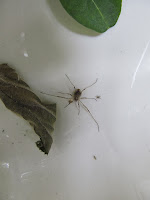
Harvestman (Paroligolophus agrestis)
Sawfly larvae
Barkfly larvae


 This gorgeous member of the Crab spiders


A typical leafhopper adult


A teeny tiny weevil (Apionidae)


What I reckon is a potato leafhopper but as leafhoppers are quite variable its hard to be sure!


A big fat female Garden Cross spider.


This cute little sawfly larvae


A kind of sac spider.


Adalia bipunctata


A two spot ladybird (Quadrimaculata).

Why don't you have a go in your garden or park and see what you can find - all you need is a light coloured tray (washing up bowl would do!) or a white sheet stretched over a wooden frame, hold it under the bush or tree while you give it a good shake. Remember to return the organisms to the area where you found them :)