Tuesday, 27 January 2015

On Cousteau

I received a series of Jacques Cousteau DVDs for Christmas this year which was an excellent present for a budding marine & freshwater biologist ;)


If you did not already know, Cousteau was a French naval officer, explorer, conservationist, scientist, filmmaker and researcher who along with Emile Gagnan developed the aqualung (or SCUBA system as it is known today) in the early 1940s. He was also a pioneering marine biologist and traveled the oceans during with his son and crew on the adapted marine biology station ship, Calypso, for the series The Undersea World of Jacques Cousteau between 1966 and '76. He developed mini submersible exploration vehicles which were launched from Calypso and enabled him to film amazing scenes of life underwater and bring attention to the negative human impact on the oceans.

He also predicted the existence and use of echolocation in porpoises as he observed them finding the optimal course through the Straits of Gibraltar without following a boat. He certainly was a busy monsieur!

Of course marine biology was a bit different back then, and some of the 'techniques' used to study the animal life would definitely be frowned upon today! Here are a couple of examples:

  • Trapping tropical fish under plastic domes while their natural predators try to get at them and eat them.
  • Prodding a pufferfish until it inflates itself.
  • Drilling a hole at the rear of a turtle's carapace (which does not cause the animal any pain) and tying a hydrogen balloon to it to track them.
  • Attaching a plastic ball float to a fin whale to track it, combined with divers hanging on to its tail and fin for a bit of a ride before they let it go about its business.
  • Securing a tag to a juvenile sperm whale with string around its body.

Monsieur Cousteau riding a turtle, as you do.

Despite the perhaps slightly dubious methods, there are many fantastic insights into the deep sea including a couple of species and behaviours that I hadn't seen on other natural history documentaries (even recent ones) before.

An additional bonus for me was that the series is narrated by Rod Serling of The Twilight Zone fame, which, for those that are too young, is referenced in Futurama's The Scary Door! The series is seriously worth a watch :)

Next up on Mosspig - the first CRIMP survey of 2015!

Monday, 5 January 2015

Oh Canada!


The view from Moresby Floating Camp on Haida Gwaii

To wrap up the loose ends from 2014 I am finally getting around to writing about the wildlife we saw when we visited the west coast of Canada. We toured around Haida Gwaii (formerly known as the Queen Charlotte Islands) and managed to see most of Vancouver Island too. We were incredibly lucky in that we hit most of the big scores in terms of animal spotting. I realise that lists are sometimes dull and boring but I'm sticking them in here anyway!

Birds
  • Tufted puffin
    Tufted puffin ((Fratercula cirrhata) around Haida Gwaii
  • Ancient murrelet
  • Pigeon guillemot
  • Belted kingfisher
  • Loon
  • Bald eagle
  • Raven
  • Chickadee
  • Rhinoceros auklet
  • Sandhill crane
  • Semi-pilated plover
  • Turkey vulture
  • Blue heron
  • Steller's jay
    Bald eagle - Haliaeetus leucocephalus
  • Sandpiper
  • Shearwater
  • Barred owl
  • White winged scoter
  • Wood duck
  • Sap sucker
  • American Robin

Yes, we saw a huge variety of birds and spent a great deal of time trying to get half decent photographs of them. Of course the most iconic one is perhaps the bald eagle, of which we saw many as we made our way around both islands. There was one particular creek on Haida Gwaii where we stopped for lunch which was jam packed with adult and juvenile eagles, some flying very closely past us. One of the memorable species was the ancient murrelet, which had a frantic and slightly ineffectual flapping flight using their stubby wings whenever the boat got too near. Haida Gwaii has the largest breeding colony of ancient murrelets in the world don't you know.

One of the birds we had a particularly hard time trying to photograph was Steller's Jay, and on one occasion following one with the camera led us to a very well camoflaged, sleeping, barred owl!

Mammals
  • Humpback whale
    Pacific White Sided Dolphin - Lagenorhynchus obliquidens
  • Sitka black tailed deer
  • Haida Gwaii black bear
  • Squirrel (various)
  • Pacific harbour seal
  • Steller sea lion
  • Bats
  • Killer whale
  • Pacific white sided dolphin
  • Grizzly bear
  • Californian sea lion
  • Racoon

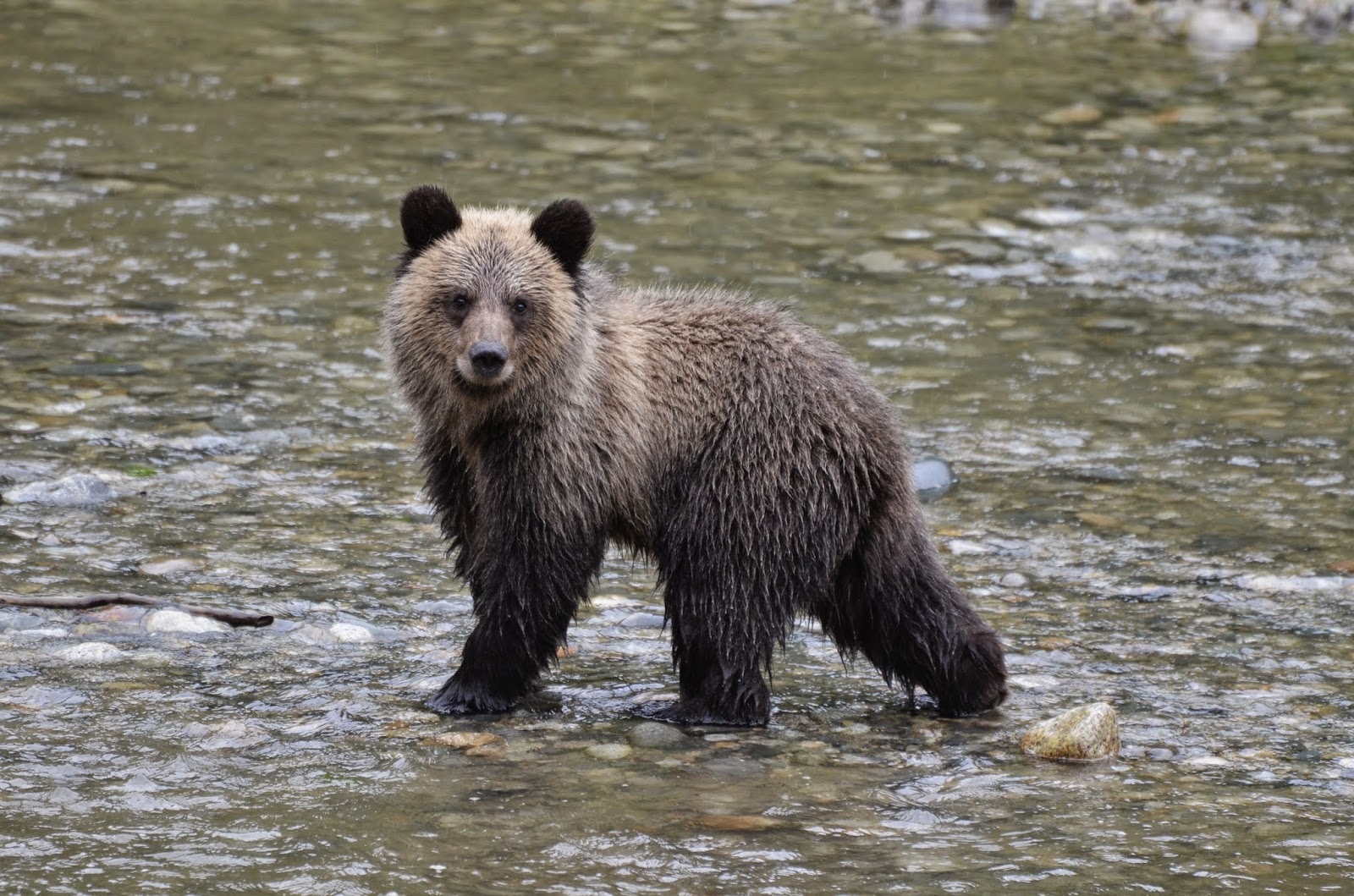
We spent a lot of our time in the lead up to going to Canada hoping that we'd see bears and whales, and we were definitely not disappointed! Shortly after we had arrived on Haida Gwaii a black bear lolloped across the road in front of our bus. The grizzly tour that we went on in Campbell River  provided us with spectacular viewings of humpback whales, a pod of killer whales, pods of pacific white sided dolphin and of course the beautiful grizzlies. We managed to see five bears in total on the tour, two female and cub pairs and one lone individual, and all turned up just shortly after we had climbed into the hide!

Grizzly bears - Ursus arctos horribilis

The mother bears looked very lean but were obviously doing well as the cubs were one and two years old respectively. They came so close to where we were watching them but didn't pay much mind. They skirted the icy blue glacier river and one mother even dived in attempting to catch a salmon.


What a amazing unforgettable day that was! When we were nearing the end of our holiday we booked on a whale watching tour in Victoria and were also very lucky to catch a couple of big humpbacks breaching out of the water. There are different theories as to why humpbacks perfom this behaviour ranging from social displays of dominance, playing, dislodging parasites or to stun prey. Humpbacks are mysticete whales meaning they have baleen plates in their mouths instead of teeth which they use to filter feed on small crustaceans and fish. They are generally solitary animals but the males are well known for their haunting and complex songs produced to attract a female during the breeding season.

Humpback whale Megaptera novaeangliae

Other behaviour we observed while on the inside passage ferry were tail and fin slapping by two different individuals, which was great to see.  Tail slapping, or lobtailing as it is often called, creates a sound that can be heard for several hundred meters underwater, it may be a form of communication or feeding method to encourage frightened fish to school together to make them easier to catch.

Humpback tail fluke patterns and notches can be used to identify individual whales

Fish, amphibians and invertebrates
Sunfish Mola mola
  • Sunfish
  • Banana slug
  • Sculpin
  • Purple or Ochre starfish
  • Northern kelp crab
  • Fried egg jellyfish
  • Grasshopper
  • Isopods
  • Mossy and Black Katy Chitons
  • Carabid ground beetles
  • Tussock moth caterpillar
  • Western red backed salamander
  • By-the-wind sailor jellyfish

One of the weirdest things we encountered was a sunfish, a giant meter and a half laterally flattened silvery grey creature with huge oar-like dorsal and anal fins. It is apparently the heaviest bony fish in the world reaching weights of 1000kg. They mainly eat jellyfish and are very slow moving and a result can end up with a lot of hangers-on in the form of parasitic species (and they can be troubled by as many as 40 different ones!), which we observed on ours! Sunfish sometimes come to the surface for a clean, and allow birds to eat parasites from them, at the surface they can also take advantage of the warmer temperature and thermally recharge before they dive.

Mossy chiton Mopalia muscosa
It wouldn't be a Mosspig blog without some mention of inverts so I'd like to highlight the chitons we found on Botanical Beach at Port Renfrew. These are molluscs of the polyplacophora class which have 8 overlapping parts to their shell made of calcium carbonate, which enables them to fit very snugly against intertidal rocks to lock in moisture and avoid becoming dislodged by the waves. Like snails, chitons have rasping tongues called the radula, which are covered in ordered rows of tiny teeth. These are used to scrape algae from rocks on which the chiton feeds. A surprising thing however, is that chiton are the only animals that are able to tip their radular teeth with a compound called magnetite which is the hardest material made by a living organism! There are chitons present on Scottish rocky beaches of course but I have never seen them as big as the ones in BC. There is also a really weird story in Haida culture regarding chitons and their involvement in the creation of man which is worth a read.

Tussock moth caterpillar Lophocampa maculata
Banana slug - Ariolimax columbianus
One of my favourite 'underdog' spottings was the humble banana slug. They are present in North America's Pacific coastal coniferous forests, but the ones we saw in British Columbia are an isolated population. They are very important as they are detrivores, which means they feed on decaying vegetation, animal droppings and fungal fruiting bodies which enables recycling of nutrients and a clean and healthy forest. They are also a tasty snack for some birds and mammals, and I think they are very charismatic!


Of course I can't end a post about British Columbia without mentioning salmon. There are many different species in Canadian waters including Sockeye, Coho, Chum, Pink and Chinook. They all start life in interior rivers, migrating out to sea where they feed and grow, and then return as adults to spawn in their natal river. The return of the salmon is a huge and important event for the bears who after a summer of eating fruits, nuts and scavenging carcasses, can gorge on the glut of salmon biomass in the fall. Bears and other carnivores that hunt the salmon enrich the local ecosystem by transporting nutrient-rich flesh onto the land and into the forests. There valuable phosphorus, carbon, sulphur and nitrogen and be broken down and taken up by plants and trees, as well as being transported downstream to estuaries where it can support a wide variety of invertebrate and birdlife. Mon the salmon!

Sockeye mural in Prince Rupert

In conclusion I thoroughly recommend exploring British Columbia and especially Haida Gwaii and Vancouver Island if you ever get the chance, it is a beautiful area bursting with amazing creatures as well as fantastic scenery.

Saturday, 3 January 2015

On Taxidermy

Preserved teddies (Shadowmanor.com)
I've been pondering recently why I am drawn to taxidermy and associated animal preservation. Every time I visit a museum with a natural history section I'm excited to see what wonders they have on display. Collection of butterflies and beetles in wooden framed boxes, exotic colourful birds filling glass domes, and prowling predators frozen in time are indeed candy for the eyes!

Alfred Russell Wallace's collection of butterflies in the NHM London
Taxidermy enables us to get up close and personal with animals we might never get a chance to see alive in the wild, and even preserves those that are now sadly extinct. When done well, the art of taxidermy can bring a second life to dead animals, and some imagination and a bit of artistic license can even create new wondrous creatures like unicorns, flying cats, and jackalopes. Even mixed media creatures featuring jewelled or mechanical parts are commonplace these days - check out the work of Jessica Joslin and Brooke Weston for some of my favourites.

'Custard' by Brooke Weston

Vast displays of taxidermy or 'museum skins' (where only the skin is preserved and not stuffed, to enable specimens to be studied and stored in smaller spaces as in museum collections) also allow us to appreciate the massive variety of forms that occur in nature. Many variations of colour and patterning between species can be marveled at, the products of millions of years of evolution. Some of my favourites include the huge tree of hummingbirds at London's natural history museum and also the hummingbird display at Tring NHM. Walking through the massive gallery of even-toed ungulate antelopes at Tring to observe the variety of antlers and horns was a definite highlight for me.


Collection of beetles

Gallery at Tring NHM

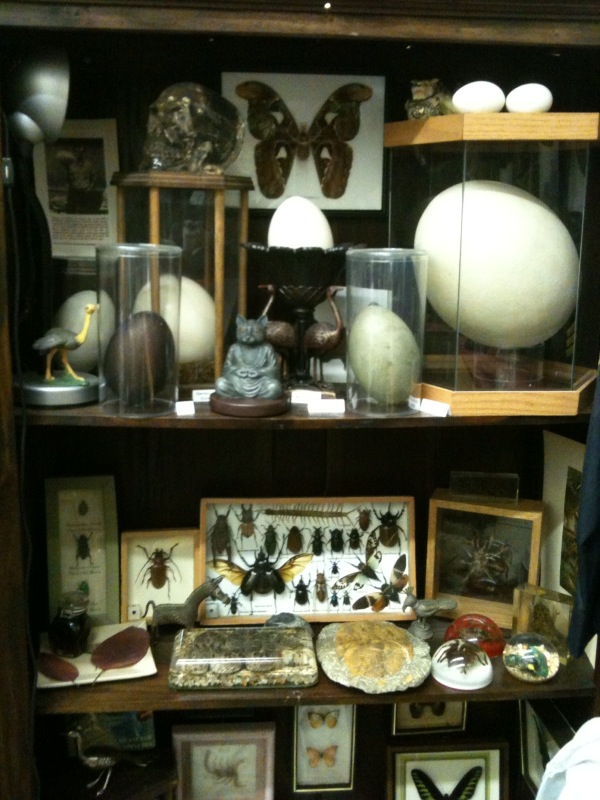
Wunderkammer, curiosity cabinets packed with bones, crystals, insects and preserved specimens in jars of formaldehyde, once a macabre Victorian fascination seem to also be back in fashion. When I was little I kept an small old suitcase filled with bits and bobs I had collected (I still have it but most of the things are now displayed proudly around the house!). An antler, feathers, stones with holes through them, things in small bottles and jars, dead butterflies and tiny bird bones all hoarded. It felt magical, making a connection to the past and to nature, having a small trove of treasure unlike anyone else!

A fantastical combination of various animal parts by Enrique Gomez Molina, who got into a bit of bother for illegal trafficking of endangered species, don't do it kids!

A cabinet of curiosities


Trying to make a dead bird seem as if it could take flight at any moment is an art indeed. Through the practise of taxidermy I am learning more than I ever thought I would about animal anatomy and physiology. Although surrounded by photographic references while I work, it is so important to observe the living versions going about their business too. You need to be aware of what a 'natural pose' really is. There is no substitute for studying wildlife in its natural setting.
Can a stoat bend that way? At what angle should the tail of a robin sit?
Stoats, surprisingly bendy.
Every day is a school day.

Textures and colours are a huge draw for me too. Types and patterns of fur and feathers can be appreciated at close hand. I am sure there are some of you out there that think all birds are entirely covered in feathers -  not so! Feathers grow in tracts and there are patches of bare skin called apteria which birds use for cooling. Penguins however are entirely covered in feathers to enable them to inhabit the freezing temperatures of the Antarctic. When you are blasting a soggy crow skin with a hairdryer you definitely get an appreciation for these adaptations!

Red Crested Turaco
Araripe Manakin
Grey crowned crane
Mandarin Duck

Fairy Penguin in Australia, not Antarctica.
Although as a amateur the process of taxidermy can sometimes be very frustrating, the rewards are great. Appreciation, understanding and a lasting memorial which can be enjoyed over many years are my treasures.

Monday, 22 December 2014

Christmas CRIMP

When is the best time to go wading in a river? That's right, WINTER!

 
There's more life in here than meets the eye!

The last riverfly survey before Christmas was indeed a very chilly one. The river was a lot higher than usual due to the heavy rains recently but that didn't stop us from catching some cool beasties! I've caught a couple of brown trout parr on the odd occasion like the little guy below, however I've never had a stickleback land in my net, never mind two of them!

Brown Trout parr
Three-spined Stickleback Gasterosteus aculeatus
Sticklebacks are common in UK rivers and ponds, usually reaching a length between 4-7cm and living for up to 3 years. They are unusual in that they do not have scales on their body like most fish, but instead have bony armour-like plates, as well as the characteristic spiny protrusions on their backs. Sticklebacks are normally schooling fish but during the breeding season in the spring the males become very territorial and develop a red patch under their belly to advertise their dominance over other males and to attract a female. The male also takes on parental care duties, building a nest using bits of weed, chasing rival males away, and ensuring that the eggs are well oxygenated once the female has laid them. Once the eggs have hatched he will capture any fry that try to escape by sucking them into his mouth and depositing them back in the nest. He will do this until the young are big or strong enough to escape him!

We also caught some familiar faces in the form of pea mussels, pond snails, and various leeches. Leeches can survive in a wide variety of freshwater bodies including those with low dissolved oxygen which may indicate polluted waters. However as we are also regularly finding large numbers of blue olive mayfly, flat bodied upwing, caddis and stonefly larvae which are all very sensitive to pollution, we can assume that this river is healthy for Christmas. Yay!

Leech, possibly Erpobdella sp. next to a flat bodied upwing larva 

Sunday, 7 December 2014

Burning Like Fire

My most recent taxidermy victim subject has been a young wild rabbit:


 This is the first rabbit I've tried my hand at and I'm quite pleased how it turned out, the only problems are with the nose and lips which need filled out a bit more, and that it's sitting on its bum where it should really be supported by the hind legs. Every day is a school day so these are things to remember for next time! It was great blow drying this critter with the hair dryer as it was so fluffy and soft.


As I don't have a dedicated space or workshop to do taxidermy, I need to make sure I complete the animal in one day, and this often leads to, ahem, frustration towards the final stages! Hopefully in the future I'll have a shed and a 'taxidermy only' freezer, so that I can put a specimen on hold to finish off another day, it would take away so much stress. I found a quote on the excellent website of professional taxidermist Mike Gadd -

I know you can get tired when working on a project for a while and frustration can set in towards the end so that you feel like screaming and throwing the thing across the room.  This is quite normal behavior for a taxidermist and in my early days with no books to help, I sentenced many a poor animal to flying without wings.

Never a truer word said, especially on a different particularly small and fiddly animal I've been working on this weekend. All will be revealed after the Christmas period :)

Looking out of the window...forever

Friday, 24 October 2014

CRIMPing my Style!


For the past three months I have been carrying out monthly riverfly surveys on behalf of the Kelvin Angling Association and in conjunction with Clyde River Foundation's CRIMP programme. I also had my 5 minutes of fame being featured in one of the CRF's blog posts! 
Last month's kick sample turned up a couple of surprises which I thought I'd share!


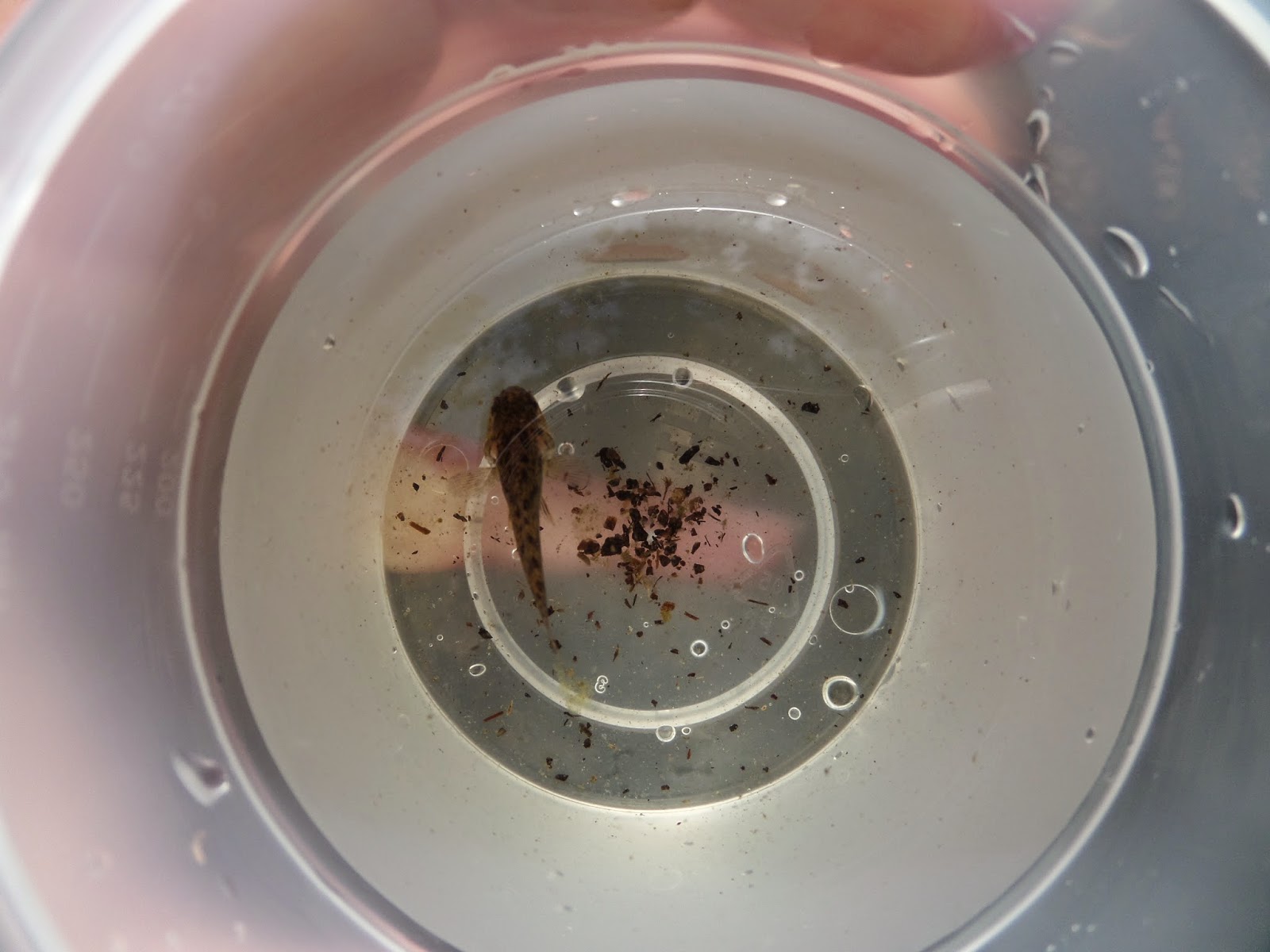
 The first was a stone loach (Barbatula barbatula) who found his way into the net. These guys are bottomfeeders in clean rivers (a good sign for the Allander!) and use their distinctive barbels that can be seen near the mouth to detect food. He's probably been snacking on some of the riverfly larvae I'm looking for.


The next surprise was in the form of a member of the leech family Hirudinae which I think is Glossosiphonia complanata. It has 6 tiny light detecting eyespots at the pointed end and feed of freshwater snails and midge larvae - a good thing for us ;) It has a sucker at the front and rear of the body and can hold onto the substrate with a fantastically strong grip, as I found out when I tried to wash him out of the tray back into the river, he just wouldn't budge.


 This brown mass consists of 43 Gammarus, or freshwater amphipod, these are indicators of clean oxygen rich water. They're very nippy in the water too, tricky to catch as they are so fast.


These are flat bodied upwing members of the Heptageniidae family of mayflies (approximately 30 individuals shown here). Their flattened shape helps them cling to rocks and avoid being washed downstream as they are not great swimmers. These guys are also good indicators of water quality, they can tolerate a little pollution but need oxygen rich water to survive. 

I'll be carrying out October's survey soon so stayed tuned to see if I find anything interesting :)

Thursday, 23 October 2014

Back to school!

I wrote this blog a few weeks ago and have only got round to posting it now...that's how busy it's been!

Yes it's finally the end of my summer and I'm back at uni in my third year. We kicked things off with a full-on week residential field course at Loch Lomond featuring invertebrate sampling, electro-fishing and experimental design! I thought I'd share some photos of our caddisfly experiment, where we caught a fair few of the leptoceridae family (which normally construct their cases from plant matter) and challenged them to build cases from a variety of different substrates. We had a couple of naked caddis larvae in dishes with either plant bits, sand, gravel, or plastic and left them for a couple of hours to see what they would do!

Ruffe caught during invert sampling in Loch Lomond
Dragonfly nymph
Red velvet mite
The bonnie banks
Brown trout caught while electrofishing
An eel!
Our caddisfly experiment
What caddisfly cases usually look like.
Our resourceful caddisfly larvae building with plastic
Naked caddis larvae!

I have also been dissecting earthworms, periwinkle, limpets, shore crab and a squid in uni labs to aid the learning experience. It's been a busy time and I've had a fair amount of coursework to get through but hopefully this weekend I'll have a taxidermied rabbit to show you :)